


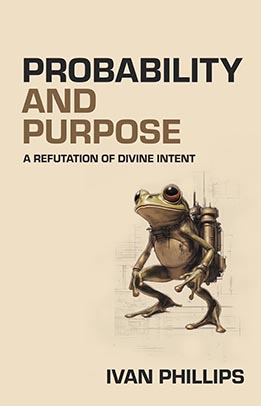
Thoughtful theists and atheists tend to agree that Darwin’s evolutionary biology took the theist’s argument from design off the table, at least as far as biology is concerned. Yet, it seems to many of us atheists that evolution ought to do more than neutralize the argument. Doesn’t it seem at least a little weird that a God would choose to use evolution to create life?
So, one day, I decided to think about the relationship between natural evolutionary biology and design in terms of Bayesian probability. I expected to conclude that, yeah, maybe we ought to be twice as confident in atheist as a consequence of the fact of evolutionary biology. Or maybe ten times as confident. But I was shocked when my analysis shows that evolutionary biology essentially rules out all divine design in biology. It doesn’t neutralize the theist’s argument from design, it inverts it. I call it the Counterargument from Design
This argument changed my own atheism. Previously, I was an atheist because I thought that the atheist arguments were better than theistic arguments, and, taken holistically, atheism was the more rational conclusion. Today, I think the Counterargument from Design is so much stronger than every other argument that nothing else really compares.
Here’s how the argument works. If the world is governed by simple, non-mental, natural laws, then the only way life can arise is through evolutionary biology. Evolution is highly restrictive, and makes quite narrow predictions that we would expect to find on every living world. In my book, Probability and Purpose, I consider 8 of these predictions:
- Descent/reproduction
- Common descent
- Common composition
- Millions of species
- Long timelines (e.g., billions of years vs 6 days or 6 nanoseconds)
- The only apparent utility is survival (versus, say, cooperation of all species)
- Animals only know what they could have cognitively or genetically learned
- No supernatural creatures
Of course, our biological observations are consistent with all these predictions.
In contrast to natural evolution, supernatural design has no such limitations. This has consequences that we do not easily intuit. The human instinct is to answer the question, “Can God create a world that looks evolved?” to which the answer is always “Yes.” But the question should be, “Is it likely God would do this?”
Just take a few minutes to put your fantasy thinking cap on and devise divine deviations from these evolutionary constraints, and you’ll see that there are an infinity of beautiful, valuable worlds that a God can create that are beyond the reach of evolutionary biology.
An all-powerful designer has infinitely more ways of designing life than evolving it. That is, worlds that look evolved constitute an infinitesimal sliver of the possible worlds a designer could make. Statistically, an all-powerful designer will not create an evolved world.
Thus, finding ourselves to be evolved, we should conclude that life as we know it was not intended. This argument says nothing about designers who create the universe not caring what arises as a consequence. But such deistic gods are of little relevance or interest. People generally care about God when they think God intended our existence or intended our actions be one way versus another. If humans were not intended at all, then God is, well, irrelevant.
The statistical argument I present is not intuitive. If it were, it would be discussed much more. If you are a statistically normal person, the argument might feel wrong. You may even have come up with some objections already. Indeed, the longest chapter in my book is a discussion of the a dozen or so objections that I was able to anticipate. Thus far, I have found no convincing objections.
What do you think? Do you have a favorite objection?
Leave a Reply